
Trump’s Obsession With Latin America Is a Strategic Calamity
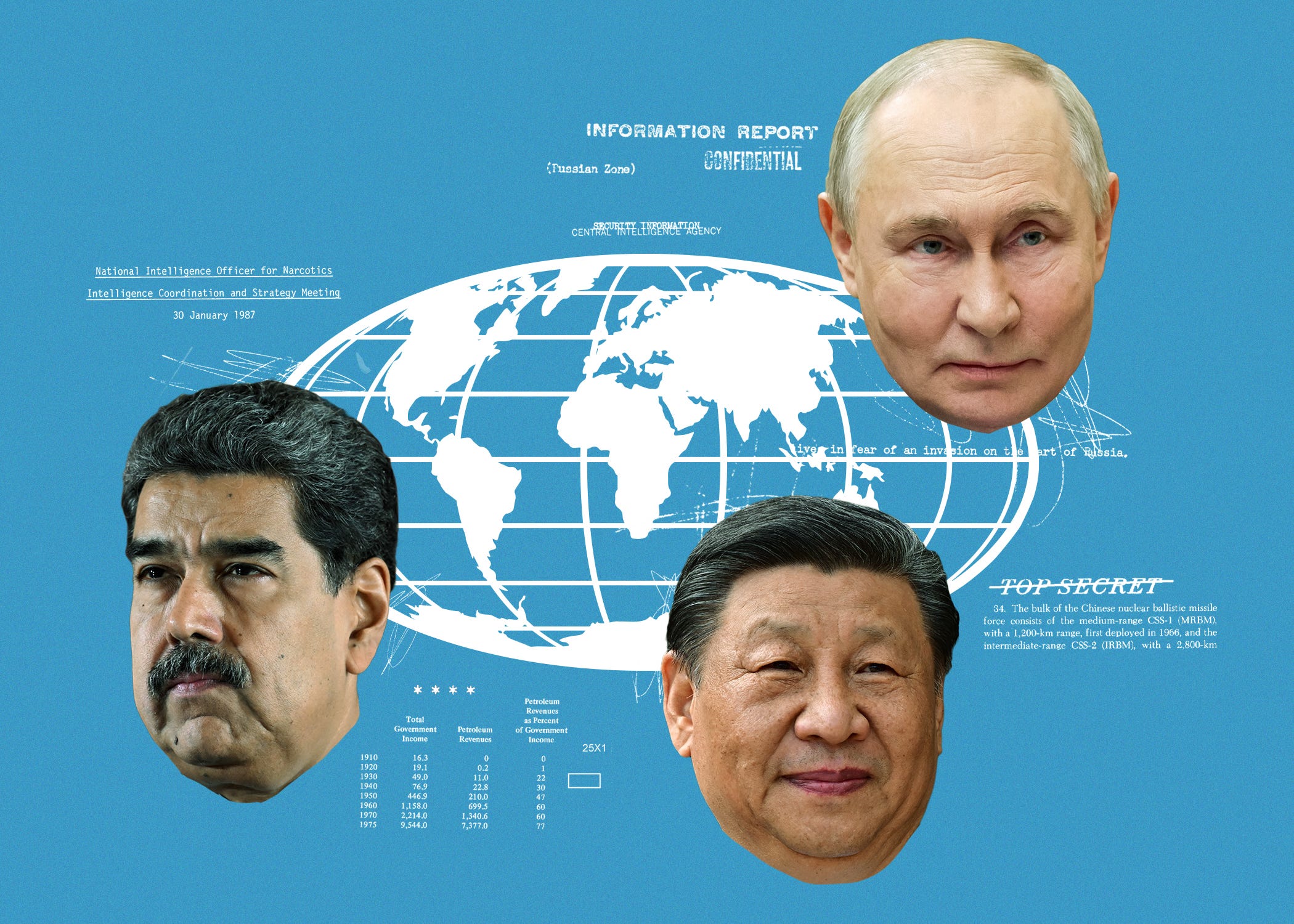
DURING A PRESS CONFERENCE after U.S. forces bombed Caracas and captured Venezuelan dictator Nicolás Maduro, President Trump declared that the United States would “run the country until such time as we can do a safe, proper, and judicious transition.” He has no idea what he’s getting into. “We’re not afraid of boots on the ground,” he claimed. He said, “We were prepared to do a second wave,” but observed that it was unnecessary because the “first attack was so successful.” He repeatedly emphasized that the United States will “run” the country. When reporters asked who would be in charge, he pointed to Secretary of State Marco Rubio, Defense Secretary Pete Hegseth, and Chairman of the Joint Chiefs of Staff Gen. Dan Caine: “It’s largely going to be, for a period of time, the people that are standing right behind me.”
Trump announced that Vice President Delcy Rodríguez—who is now the country’s interim leader—could remain in power as long as she “does what we want.” He has also threatened her: “If she doesn’t do what’s right,” he said in an interview with the Atlantic, “she is going to pay a very big price, probably bigger than Maduro.” But what if the country’s security forces refuse to cooperate? What if rogue elements within the government view her as an American stooge and revolt? What if fighting breaks out between paramilitary groups, outside armed organizations and gangs, or rival factions in the military? Will Trump commit a larger force to the region if that’s what it takes to stabilize a country twice the size of Iraq?
Trump cites his other “perfect” military actions—such as the assassination of Iranian Gen. Qasem Soleimani and the bombing of Iran’s nuclear sites last summer—as evidence that the United States doesn’t have to get embroiled in long regime change wars. But unlike those one-and-done operations, the attack on Venezuela lopped off its head of state—a move that could lead to far more chaos and instability than Trump expects.
Beyond all the dangers of this operation, there’s a deeper problem: The removal of Maduro is the opening move in a reckless new American grand strategy that will be self-defeating in an era of renewed great power conflict with Russia and China. Trump is ignoring the theaters that actually matter to fixate on a part of the world that poses no threat to the United States.
To get the most important details, the clearest big picture, and the analysis that connects it all, become a Bulwark+ member.
“UNDER OUR NEW National Security Strategy,” Trump said during the press conference, “American dominance in the Western Hemisphere will never be questioned again.” The Trump administration’s recently released National Security Strategy announced that the United States will “reassert and enforce the Monroe Doctrine to restore American preeminence in the Western Hemisphere.” Trump says his administration has “superseded” the Monroe Doctrine, and he proudly describes this new strategy as the “Donroe Doctrine.”
The National Security Strategy calls for the “readjustment of our global military presence to address urgent threats in our Hemisphere.” According to the U.S. Southern Command, there are around 15,000 American troops in the Caribbean—the largest deployment in decades. The United States’ largest and most advanced aircraft carrier, the USS Gerald R. Ford, has been in the region along with its strike group and a small armada of other ships since November. Over the past several months, the Trump administration has authorized dozens of strikes on alleged drug smugglers—extrajudicial killings that have violated the laws of war and domestic law. But the concentration of U.S. forces today would need to be drastically increased if the administration actually puts boots on the ground in Venezuela to “run” the country and tamp down any violence or civil strife that may arise. The United States doesn’t even have an embassy in Caracas.
A central theme of the National Security Strategy is that a coherent strategy “must evaluate, sort, and prioritize. Not every country, region, issue, or cause—however worthy—can be the focus of American strategy.” The Trump administration has decided to prioritize the Western Hemisphere over Europe and East Asia, a decision that empowers the United States’ two most powerful geopolitical rivals: Russia and China.
Trump’s inclination to focus American foreign policy on the Western Hemisphere is completely at odds with the reality of the world. Of the world’s ten largest economies, only one is in Latin America (Brazil). Outside the United States, the world’s productive capacity is concentrated in Europe and East Asia. This is a lesson most Americans—indeed, most of the world—learned during World War II, around the time Trump was born, when that productive capacity was used to kill people rather than to make useful things. It’s why America has its key security relationships—NATO and the hub-and-spoke alliances in the Indo-Pacific—in Europe and East Asia, rather than in South America or sub-Saharan Africa.
Not surprisingly, the story of American trade is similar. Of the United States’ top fifteen trading partners last year, only three—Canada, Mexico, and India—weren’t in Europe or East Asia. As easy as it may be to look at a map and see the United States as isolated from the Old World by two big oceans, the reality is that those oceans aren’t barriers, but highways to the parts of the world that either keep America rich and powerful or threaten its security and prosperity. This was the major lesson Americans learned from the two world wars—at least, most Americans. When Europe and East Asia are peaceful, America has good trading partners and reaps the benefits. When those regions are turbulent, the trouble eventually finds American shores.
The strategic importance of Europe and East Asia to American security and prosperity is why Russia and China are such potent threats. Russia’s war in Ukraine is part of a much larger project to undo the end of the Cold War and re-divide Europe—i.e., to revert it to a time when it was less productive and spent far more of its productive capacity on things like weapons instead of things Americans wanted to buy. Unfortunately, it has become necessary for Europe once again to spend on defense at Cold War levels.
China wants to dominate the most productive economies of East Asia, which would make them significantly less useful as trading partners for the United States. It also wants to dominate some of the major choke points in all international trade—not coincidentally also located in East Asia—so that it can bend the world’s productive capacity to its own will.
This would all be reason enough to elevate Russia and China as the major strategic foci of American foreign policy, as Trump’s first-term National Security Strategy did, above other threats like Iran, North Korea, Cuba, and Islamist terrorism. The fact that Russia is the United States’ only nuclear peer—and that China is racing to match the American and Russian arsenals—is all the more reason to devote every available resource to the regions of the world that matter most for American security.
Venezuela, for all the drug smuggling, human rights abuses, and migration challenges, is a blip on the map of geopolitical threats America must confront.
THE UKRAINE WAR IS THE LARGEST conflict in Europe since World War II, and it is the main battlefield in the global confrontation between democracy and authoritarianism. But the Trump administration has treated Ukraine like a sideshow and a nuisance. Trump initially promised that his “very good relationship” with Vladimir Putin would enable him to end the war in 24 hours. But by declaring from the outset that the United States would no longer provide significant military support to Ukraine and negotiating with no preconditions, Trump threw away his leverage. The result has been stalled negotiations as Russian attacks on Ukrainian cities and civilians have intensified.
While the Trump administration has attempted to cut Europe out of the Ukraine negotiations, it also expects NATO allies to “provide the overwhelming share of future lethal and nonlethal aid to Ukraine,” as Defense Secretary Pete Hegseth explained last year. The administration’s approach to Europe is neurotic—while Trump believes NATO allies should have no say in an eventual settlement of the Ukraine War, he also expects those allies to do all the heavy lifting that would make such a settlement possible. At a time when NATO defense spending is surging and allies have promised to allocate 5 percent of their GDP to defense by 2035, the Trump administration has responded by waging a trade war on Europe and threatening to abandon the continent when it faces the most serious set of geopolitical threats since the Cold War.
The outcome of the war in Ukraine and the integrity of the transatlantic alliance are far more important to the future of the United States’ security than the existence of a decaying petro-dictatorship in South America. But the Trump administration has made the latter a top foreign policy priority and the former an afterthought.
WHEN TRUMP TOOK OFFICE, it looked like a different strategic trade-off was about to take place. According to Vice President JD Vance, negotiating a quick end to the Ukraine War was necessary “so America can focus on the real issue, which is China.” So far, the administration has primarily focused on China by losing a trade war to Beijing. While Trump’s recent $11 billion arms sale to Taiwan is welcome, there’s little reason to believe he is as committed to maintaining the island’s independence and security as previous administrations.
In a 2024 interview, Trump was asked whether he would defend Taiwan from a Chinese attack. He responded: “Taiwan should pay us for defense. You know, we’re no different than an insurance company. Taiwan doesn’t give us anything. Taiwan is 9,500 miles away. It’s 68 miles away from China. . . . China’s a massive piece of land, they could just bombard it.” He said the island is the “apple of President Xi’s eye.” He complained that “Taiwan took our chip business from us, I wouldn’t feel so secure right now, if I was them.”
Of course Trump is happy to sell weapons to Taiwan, but the real question is whether he would come to the country’s defense in the event of a Chinese blockade or invasion. Does Xi really think that outcome is more likely than Trump attempting to strike a deal with Beijing and declaring that he averted World War III? For now, the only real deterrent that could prevent Beijing from taking action in Taiwan is the credible threat of an American military response. Trump has already severely undermined this deterrent by abandoning Ukraine. A month after Vance declared that the United States must shift its focus from Ukraine to East Asia, Taiwan’s Foreign Minister Joseph Wu challenged this view: “When people ask us whether it is OK for the United States to abandon Ukraine, the answer is no,” as this would be “seen as a victory of authoritarian states because Russia, China, North Korea and Iran, they are now linked together.” In November 2024, former Taiwanese President Tsai Ing-wen even said Ukraine needed military support more than her own country.
The Trump administration doesn’t realize how its actions in one part of the world reverberate in all the others. By shrinking from a fight with Putin, Trump made an invasion of Taiwan more likely. By invading Venezuela, Trump showed Russia and China—as well as America’s allies around the world—that the United States is shifting its focus from Europe and East Asia to the Western Hemisphere. It’s easier to dislodge a tinpot dictator in Venezuela than it is to deter great powers bent on dominating their regions. But this raises the biggest question at the heart of the “Donroe Doctrine”: Does Trump even want to deter those powers? Or does he want to carve up the world with them?
BY ALL INDICATIONS, THE OPERATION to extract Maduro was an extraordinary military success. It involved more than 150 aircraft from twenty bases across the hemisphere and was executed without losing a single American service member or piece of equipment. It succeeded on the back of a major intelligence-gathering operation, which apparently included sources at the highest level in Venezuela. But the overwhelming success of the mission may turn out to be a curse in disguise, as it will embolden Trump’s effort to bring American imperialism back to the Western Hemisphere.
In Trump’s second inaugural address, he declared that the United States will “once again consider itself a growing nation—one that increases our wealth, expands our territory, builds our cities, raises our expectations, and carries our flag into new and beautiful horizons.” He said the United States would “take back” the Panama Canal. A month earlier, he declared that the “United States of America feels that the ownership and control of Greenland is an absolute necessity.” He has repeated this claim again and again over the past year. The day after the Venezuela operation, he said: “We need Greenland from the standpoint of national security, and Denmark is not going to be able to do it, I can tell you.”
When Trump appointed Louisiana Gov. Jeff Landry—who supports the annexation of Greenland—the United States’ special envoy to the self-governing island, he said “we have to have it” for “national protection.” Landry declared that he was honored to serve in a “volunteer position to make Greenland a part of the U.S.” Danish Prime Minister Mette Frederiksen has once again been forced to respond to Trump’s threats:


Saint James Talarico (he/him)
David Harsanyi, Washington Examinerمصدر …
