
The Surprising Greatness of Jimmy Carter

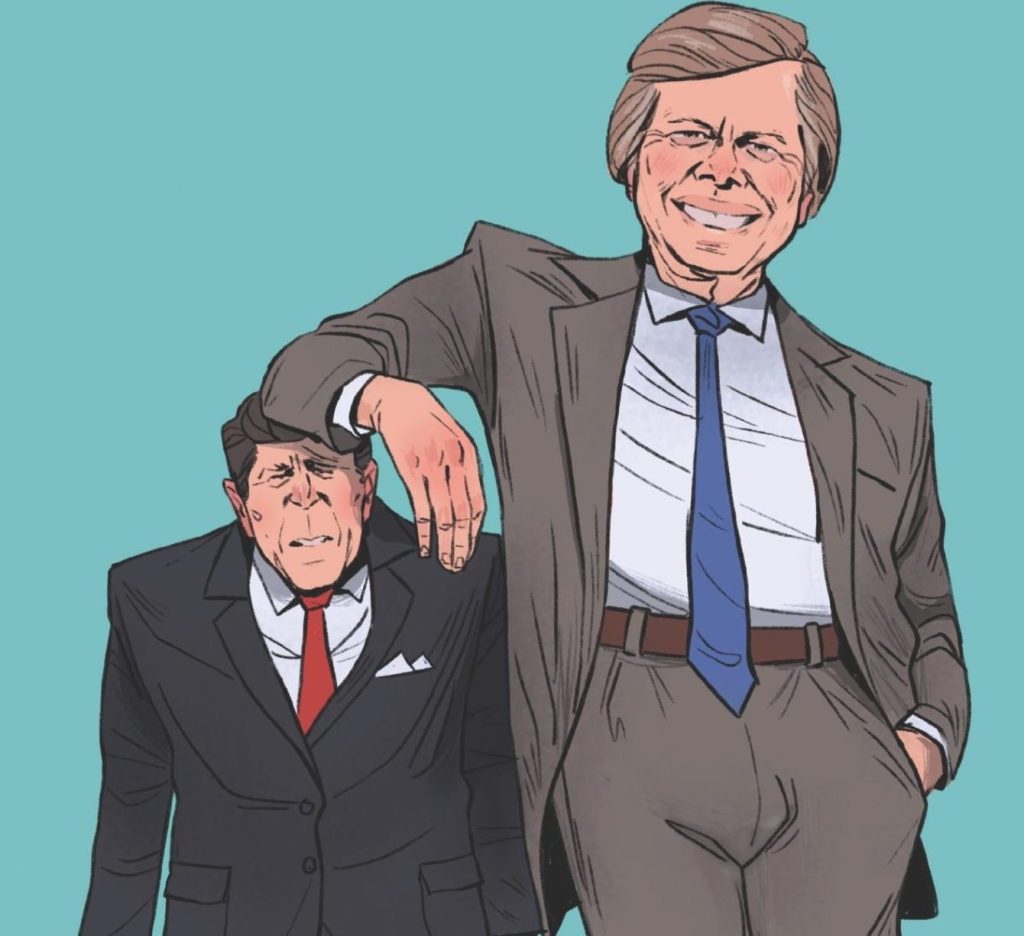
Jimmy Carter has long been cast as one of America’s least-effective modern presidents—blamed for failing to tame inflation, solve the energy crisis, or free the American hostages in Tehran. His crushing reelection defeat in 1980 sealed the downbeat narrative.
But that negative assessment is beginning to change. Recently, Washington Monthly contributing editor Timothy Noah hosted a conversation between Jonathan Alter and Kai Bird, two journalists who just published major biographies of America’s 39th president. Each approached Carter from a different angle, but both arrived at a similar conclusion: Jimmy Carter is seriously underrated.
Alter and Bird both dispute that Carter was weak or lost in the weeds, as he has so often been portrayed. Carter brought more positive change to the Middle East than any president in the decades before or since; signed more legislation than any post–World War II president except LBJ; and warned of the dangers of climate change before the threat even had a name. Carter’s human rights policy played a huge and largely uncredited role in the collapse of the Soviet Union—more so, perhaps, than any policies enacted by his successor Ronald Reagan.
What follows is an edited transcript. We promise an absorbing and informative read about some recent history that you almost certainly don’t know as well as you think you do—assuming you remember it at all.
Timothy Noah: It’s my pleasure today to introduce two old friends, Jonathan Alter and Kai Bird, to reassess the presidency of Jimmy Carter. Alter and Bird are the authors of two recent Carter biographies, His Very Best and The Outlier, in which each of them argues for a reconsideration of the former president’s administration. Carter is now 97 years old, which makes him the oldest ex-president in history. Rosalynn, his wife, is 94.
As it happens, the late 1970s is when I first met Jon and Kai. For the record, Jon and I met my freshman year in college, and Kai and I met when I was a summer intern at The Nation in 1979; Kai was my boss. I later succeeded Jon as an editor of the Washington Monthly, and Kai and I reconnected after he and his wife, Susan, moved to Washington, D.C.
I’m going to turn this conversation over now to Jon and Kai, asking Jon to begin.
Jonathan Alter: One of the most pleasurable parts of [this experience] for me was getting to know Kai. We met at the Carter Center Weekend in 2016. To my mind, [we] were engaged in basically the same larger project, which is to get the country to reassess Jimmy Carter, not just as a president but as a person. I think we’ve made some progress on that.
I think the period of time that has elapsed since he left the presidency 40 years ago is about the same as it took to reassess Harry Truman’s legacy. Truman left office in 1953 as a really unpopular president. When David McCullough’s book came out about him [in 1992], it began a true revisionism. I don’t think it’s going to be quite the same level for Carter that it was for Truman, but the reappraisal is under way, and long overdue.
The Carter administration prioritized human rights to an extent that no previous president had done, and this was an extraordinarily important thing. It helped lead to the end of the Cold War, as Larry Eagleburger acknowledged, as Colin Powell has acknowledged. When Václav Havel would give interviews, he would describe how important it was for the morale of dissidents to know that they had a friend as president of the United States. There are a lot of human rights organizations that arose, not just in the Soviet Union but in many other countries where when you talk to the people who started those organizations, they mention Carter.
There’s a story about a prisoner of conscience in the Soviet Union who Carter gets released in a prisoner swap, and he comes to church with him in Plains, and when they’re in church, he’s sitting next to Rosalynn, and he pulls from the fake sole in his shoe a little picture that he kept in there of Jimmy Carter, the whole time he was
in prison.
TN: Wow.
JA: So ideas have power. This is important to remember, even in the wake of the war in Afghanistan. You’re hearing some talk of human rights there, but having spent 20 years in Afghanistan, everybody’s now saying, “Well, we can’t, we can’t solve every human rights problem.” Carter would agree with that. It was a very pragmatic policy and situational policy.
That means he did what he could, which was a lot, particularly in Latin America, which went from mostly authoritarian to mostly democratic in the 10 years after Carter was president. That’s not all attributable to him, but he should get some credit for it. There are still many more democratic countries in the world now than there were in 1980. And it’s because of a lot of hard work by people who, in a surprising number of cases, were inspired by Jimmy Carter.
Kai Bird: I would agree with that. Human rights was a major achievement by Carter. He put human rights, that principle, as a keystone of U.S. foreign policy, and none of his successors have been able to walk back from that or ignore it completely. They’ve talked about some of the hypocrisy and impracticality of the policy, but you can’t ignore it. I make this argument in my biography, that human rights, the talk about human rights, and the focus on dissidents in the Soviet Union, and in Czechoslovakia, and Poland—all of that did much more to weaken the Soviet empire in eastern Europe than anything Ronald Reagan did by increasing the defense budget or threatening Star Wars. The Soviet Union was a weak adversary, not a strong adversary. It was falling apart, and along comes Carter, talking about human rights, and as Jon has said, ideas are powerful, and this idea remains powerful, and it really contributed monumentally to the falling of the Berlin Wall and people seizing power in the streets, and wanting to have personal freedom. That, in part, can be attributed to Jimmy Carter.
TN: The Carters recently celebrated their 75th wedding anniversary in their hometown of Plains, Georgia. You were both in attendance. What was it like, and what did you learn?
JA: They’re the longest-married presidential couple in American history. They’ve been married now longer than [were] Queen Elizabeth and Prince Philip, which everybody thought was some kind of world record. They actually met three days after Rosalynn was born, almost exactly 94 years ago, when Lillian Carter, Jimmy’s mother, brought her nearly three-year-old son around to see the baby that she had just delivered down the street. They didn’t really see each other very much for the next 20 years, though. They started going out when he was at the Naval Academy.
What really struck me about the delightful wedding anniversary was how small-d democratic it was. It was a real contrast to, say, the Obama 60th birthday party. And not just because, you know, they weren’t cutting close aides from the list. Yes, Garth Brooks went, but it was not that kind of event. It was also a mending of old wounds, because Bill and Hillary Clinton, who hadn’t gotten along at all well with the Carters, came, as did Nancy Pelosi. I have this enduring image in my mind of [Pelosi] going up to Carter in his wheelchair and putting her hands on either side of his face and looking at him long and hard, and you knew that she was thinking, “This is the last time I’m ever going to see Jimmy Carter.” So there was a poignancy to it.
They split us up into classrooms at the Plains High School, so that the party had an intimacy to it before we joined the larger group in the school auditorium. In my classroom you had everyone from Lucy Johnson and Sam Donaldson to Rosalynn’s hairdresser and a young Georgia researcher that they had befriended because they liked his nature research. It just really gave you a sense of the scope of their interests, and the fact that they—I wouldn’t describe Jimmy Carter as humble; I don’t think any politician is humble—but the modesty of his circumstances and their approach to life was on striking display.
KB: Jon, just to jump in on that theme, in my classroom I was in the presence of a billionaire who had befriended Carter 25 years earlier and helped to fund the Carter Center and fly him around Africa in his efforts to conquer guinea worm disease, but also in the room were his fly-fishing buddies. This family from Pennsylvania that he, during the presidency, he would go up to visit occasionally and go fly-fishing with. And the billionaire explained to me rather sheepishly that the Pennsylvania fly fisherman couple were Trumpists—they voted for Trump!
JA: The fly fishermen run kind of a legendary lodge in Pennsylvania. [Carter went there] right after the 1980 convention. It was also the location of a story that Paul Volcker told me. I interviewed him not long before he died, and he said that he was at the same fishing lodge when Carter was there a few years after the presidency, and Volcker said, “I’m sorry if I cost you the presidency,” because, you know, he jacked up interest rates, they went as high as 19 percent. How was Carter supposed to get reelected when interest rates were so high? When inflation was vanquished, Reagan was in office and got all the credit. Arguably, Volcker elected and reelected Ronald Reagan. But Carter turned to Volcker, and, with a smile, he said, “There were many factors, Paul.”
KB: Volcker was certainly right up there. Another factor was his treatment by the media. One of the reasons Carter is so misunderstood is, alas, the press that he got at the time, and specifically The Washington Post, [which] sort of mocked his southern heritage—his funny accent, his dress, his demeanor, his talking, his staff from Georgia. Sally Quinn, in particular, the queen of the Style section at the time, and married to [the editor] Ben Bradlee—just went after, relentlessly, Chief of Staff Hamilton Jordan and [Press Secretary] Jody Powell.

JA: Kai is absolutely right about this, and I was really surprised to see the tone of the coverage, which influenced me at the time. What I concluded [was] that Carter was both made and unmade by Watergate. He never would have been elected president without Watergate. He starts running just a few months after Nixon resigns, and he is the antidote to Nixon. He says, “I’ll never lie to you,” “We need a government as good as its people.” He [later] said he got a better press than he deserved in 1976 because he matched the moment so perfectly. But then when he gets to office, you have a Washington press corps that is determined to prove that he’s just another Nixon, and that anybody who has that job is by definition corrupt.
KB: Remember Peanutgate? That became a sort of mini scandal that was [much] ado about nothing. And yet the Washington press corps pursued it thinking that they [could] prove that Jimmy Carter used funds from this peanut warehouse illegally in his campaign. It was young reporters like us, always trying to be Woodward and Bernstein.
JA: I had been an intern in Jim Fallows’s office in the summer of 1978. He was not yet 30 years old, and he was Carter’s first chief speechwriter, and that was what got me into the whole Washington Monthly circle, and changed my life, getting to know Jim. I left the White House very influenced by the extremely critical article that Jim wrote for The Atlantic later that year, which I think you and I have different takes on, called “The Passionless Presidency,” and—
TN: I’d like to interject here Jim’s great joke—he probably regrets telling it: “Being Jimmy Carter’s chief speech writer was like being tap dance instructor to FDR.”
JA: Yeah, that was a great line.
TN: Was that a fair comment?
JA: Let’s put it this way. The speechwriters were so downgraded, in terms of their importance in the Carter White House, that I was able to write a later piece, I think for the Monthly, entitled, “I Was a Teenage Presidential Speechwriter.” They would give me speeches to write for Carter, and Carter wouldn’t deliver them, or he would muff the line. I wrote a speech that he gave at a tobacco warehouse in North Carolina, and he ended up saying, “We’re going to make cigarette smoking even safer than it already is today.” He was just really bad at prepared speeches. He didn’t value prepared speeches; he didn’t value rhetoric. Both Kai and I use the diaries of this wonderful guy named Jerry Doolittle, who I got to know that summer, who was the gag writer and a speechwriter. Jerry is very acidic in his contemporaneous diaries about Carter’s speeches. This hurt Carter, especially in contrast to Reagan, who was such a great performer. His delivery was bad. He didn’t have an ear for language. He cut out anything that could possibly be seen as Sorensenian in its rhetoric.
I remember that summer Jim said to me, “Here’s the line you need to use. ‘We must stop inflation, and we must do it now.’ ” That was Carter’s idea of a speech.
I was so disenchanted with Carter that I supported Ted Kennedy in [the] 1980 [primaries]. And then later, [I] thought that was a really stupid thing to do, taking this perfectly fine, not-perfect president and subjecting him to this kind of challenge from within his own party. I was ashamed of having done that.
I didn’t really think about him very much until I was in a book club in 2014 in New York, and we were reading Lawrence Wright’s terrific book, Thirteen Days in September, about Camp David. And somebody knew Carter in our group, knew his grandson Jason, and brought [Carter] to our book group, and this guy was 90 years old [and] delivered this brilliant analysis, not just of Middle East politics, but a tour of the horizon. And in reading that book I realized, this was a virtuoso performance at Camp David. This was one of the great diplomatic achievements in American history. So there has to be more to this guy than “mediocre president, great ex-president.”
My editor at Simon and Schuster was the late Alice Mayhew, and she was Carter’s editor. So when I mentioned this to her, she said, “You have to do this. Nobody’s written his biography.” I didn’t know Kai, it was a little bit before Kai undertook this, and there was this huge hole in the line of scrimmage.
[Editor’s note: A third major Carter book (President Carter: The White House Years) would be published in 2018. The author was Stuart Eizenstat, Carter’s domestic affairs adviser.]I was in the Carter Library one day reading documents, in the summer of 2015, and MSNBC texted me, and they said, “Trump is announcing his candidacy. Go over to a studio [and] analyze this guy coming down the escalator.” So I did that. And I knew this was going to be a really hateful turn in our national life. I didn’t know he was going to be president. But I went back to the library, and I just remember having this overpowering feeling of relief, going back and studying Carter. He was a vacation for me for four years from Tr
Author Of article : The Editors


Saint James Talarico (he/him)
David Harsanyi, Washington Examinerمصدر …
