
Meet the Mastermind Behind Trump’s Definition of “Woman”

“Big moves on Day 1,” White House senior policy strategist May Mailman crowed on X the morning of President Donald Trump’s inauguration, linking to a news article about a forthcoming executive order. Even amid the barrage of actions during the first hours of the Trump 2.0 presidency, the order—“Defending Women From Gender Ideology Extremism and Restoring Biological Truth to the Federal Government”—was a bombshell. It directed federal agencies to eradicate every trace of what it called “gender ideology” and established new government-wide definitions of the sexes. “Woman” meant adult human female. “Female” was “a person belonging, at conception, to the sex that produces the large reproductive cell.” Men made “the small reproductive cell.” “Sex,” it decreed, was an “immutable biological reality.”
For at least two years, Trump had been promising to “get transgender out” of schools, women’s sports, and the military. “It will be the official policy of the United States government that there are only two genders: male and female,” he would tell his cheering crowds.
Riley Gaines, the swimmer–turned–anti-trans activist, fangirled, “May Mailman is my Taylor Swift.”
But the order’s sweep and audacity seemed to surprise even Trump’s admirers. “It’s perfection,” Megyn Kelly gushed on her SiriusXM show. “In my wildest dreams, I couldn’t have drafted something this beautiful.” On X, the kudos flowed in from people in the United Kingdom, Australia, and Brazil. Many of the posts singled out Mailman, a Harvard-educated lawyer quickly identified as the order’s chief author. Riley Gaines, the swimmer–turned–anti-trans activist, fangirled, “May Mailman is my Taylor Swift.”
Mailman had spent four years working in the first Trump administration, becoming an immigration hawk and close ally and friend of senior adviser Stephen Miller. During the Biden era, she landed at the Independent Women’s Forum, a Washington power player that rose to prominence by pink-washing conservative economic policies—claiming to champion women’s freedom and equality while actually working to undermine them. There, she threw herself into the anti-trans cause, going from state to state to promote model legislation, known as the Women’s Bill of Rights, that enshrined narrow definitions of “male” and “female” into law.
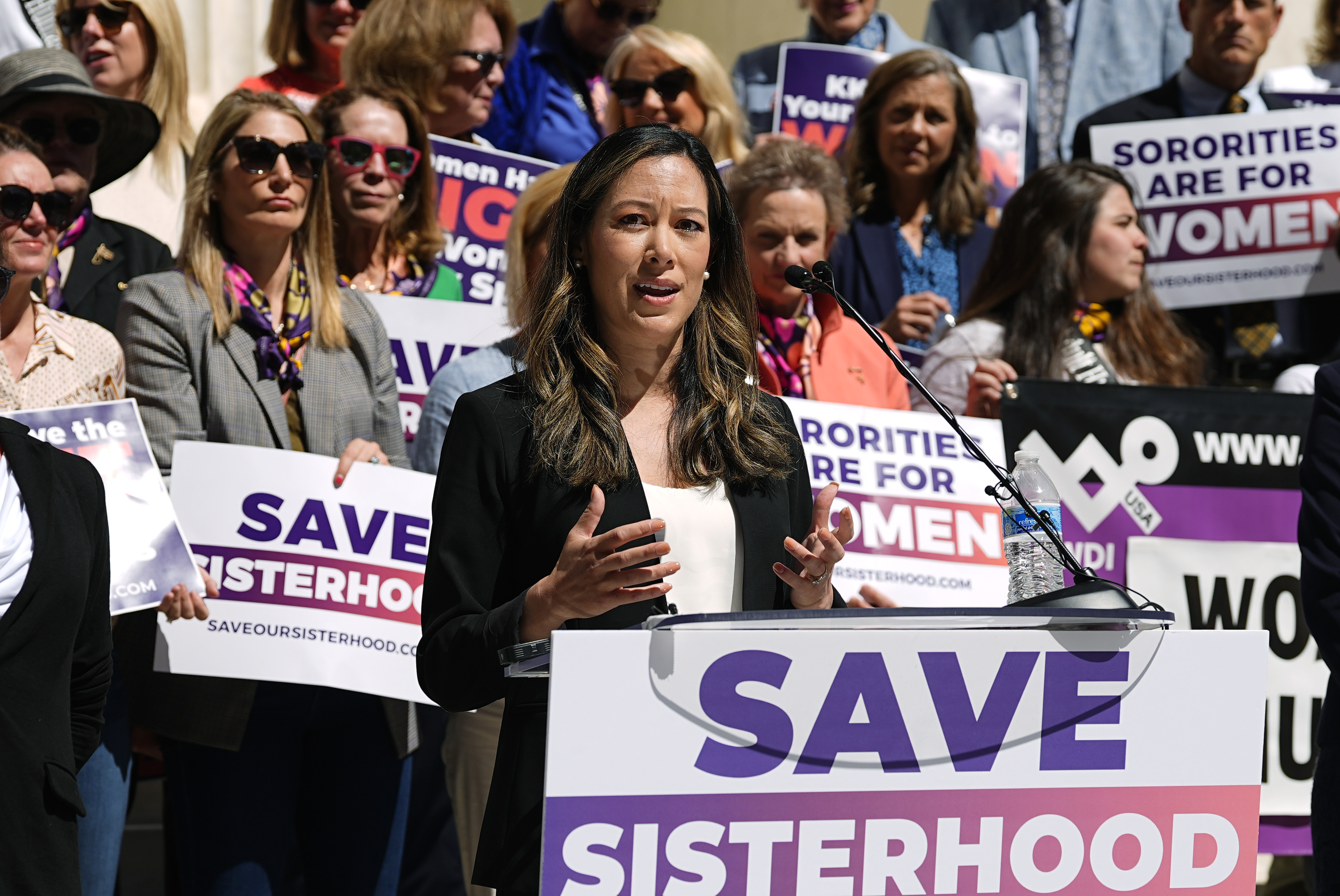
Now, at the start of Trump’s second term, Mailman was stepping into the spotlight as a White House surrogate and speaking to conservative outlets about the need to “protect” cisgender women. “If men can just assert that they are women and take women’s privacy away, take their opportunity away, take their safety away,” she told a St. Louis radio host, “then there is no such thing as women’s rights anymore.”
But there were intimations that the crusade against trans people encompassed something broader. Mailman wasn’t just anti-trans; she was profoundly dismissive of feminism. “There’s something about, you know, swiping right and left in your apartment by yourself at 11 p.m. after working a hard day that, like, doesn’t feel like feminism is the answer to all your problems,” she mocked on one podcast. She was worried about how “gender ideology” would affect men, too. “Who’s going to be our firefighters? Who are going to be our policemen?” she fretted on another.
At a Federalist Society webinar last March, she urged listeners not to even use the word “transgender,” so as not to give “credence” to the idea of “this being a category of people.” She also raised an essential question: After defining sex in the law and kicking trans women out of sports and sororities, what comes next?
The answer, she suggested, had something to do with sorting out social roles for men and women. “Trying to figure out how much do we care about gender roles, how much should gender roles infect the idea of womanhood, will, I think, ultimately affect our thinking about gender roles absent transgenderism,” she mused.
Then she stopped, as if realizing she was treading into dangerous territory, and smiled. “That conversation is maybe for another day.”

This is the story of an extraordinary effort by the second Trump administration to shape our ideas about who and what men and women are—a campaign that began with the targeting of trans people but has vast implications for the rights of cisgender people as well. At the center is Mailman, who describes herself as “one of the most effective and connected veterans of the Trump West Wing,” the get-it-done woman for Trump’s get-it-done man. “Stephen [Miller]’s the ideas guy,” she told Blaze News in April. “And then I’m trying to be the one who makes it happen.”
In her whirlwind tour through the White House last year, Mailman made quite a few things happen very quickly—including a high-profile pressure campaign against her alma mater Harvard University to adopt Trumpian priorities in hiring and admissions or lose federal funding. Then, after six months, she left the administration, returning to IWF—now rebranded as just Independent Women—to direct its law center. There, she co-authored amicus briefs in two of the biggest Supreme Court cases of the year, both involving transgender students trying to overturn laws that forbid them from playing girls’ sports. The day after oral arguments, Mailman was on Fox News complaining that some of the justices had dared to call the students “transgender girls.”
“The executive order absolutely has implications for heterosexual, cisgender women. Sometimes, I think that’s their main target.”
Her Defending Women executive order—and the other anti-trans federal decrees that followed—had an immediate, sweeping impact on the estimated 2.8 million trans Americans over age 13. On the phone several days after January’s Supreme Court hearing, Mailman tells me the push to enshrine definitions of sex had two goals: to prevent courts and administrators from interpreting existing laws in ways that are inclusive of trans people and to make voters feel alienated from Democrats. She frames the idea that transgender women are women as an “elite” concept. “If the left can’t agree that ‘woman’ means ‘female,’” she says, “there is something very othering about that to most Americans.”
Now feminist scholars are also starting to raise alarms about the order’s implications for non-trans women. They warn it could be used to undo 50 years of legal and economic progress in the workplace, health care, education, and much more. “At the moment, the most painful, prejudicial consequences are for trans people,” says Kathryn Abrams, a University of California, Berkeley law professor studying sex discrimination. But “the executive order absolutely has implications for heterosexual, cisgender women,” she says. “Sometimes, I think that’s their main target.”
For decades, much of the conservative movement has been fighting to undermine anti-discrimination protections based on sex, explains legal historian Mary Ziegler of the University of California, Davis. These include landmark laws like Title IX, which applies in education, and court decisions like United States v. Virginia, which said the government must have a strong reason, based on more than just stereotypes about physical capabilities, to treat men and women differently. Those protections profoundly reshaped American society, giving women more freedom to pursue the lives of their choosing. But they imposed new requirements on powerful institutions that balked at being regulated, and, Ziegler says, they outraged Christian conservatives who believe that “God has a plan for marriage and sexuality and the family” and “God’s plan should be written into the law.”
The right slowed the momentum for women’s equality when it killed the Equal Rights Amendment in the early 1980s and turned abortion into a wedge issue. Decades later, the anti-trans movement’s emphasis on strictly defining sex as “biological” has given conservatives a new weapon to claw back the feminist movement’s earlier gains, Ziegler says. The term “biological sex,” she says, has become “the new takedown strategy for anti-discrimination law.”

How Right-Wing Superstar Riley Gaines Built an Anti-Trans Empire
Mailman, not surprisingly, disputes that the sex definitions are part of a wider effort to weaken sex discrimination law. “Simply cementing the case that sex is real doesn’t change anything,” she tells me. “It is the status quo.” Nor does she think enshrining sex definitions based on eggs and sperm will lead to women being treated differently from men in, say, classrooms and workplaces. “There’s nothing about that that forces a woman into a separate calculus class.”
But Mailman’s allies in the conservative movement—groups like the Alliance Defending Freedom, the religious right legal organization that has led many of the biggest attacks on abortion and LGBTQ rights—have their own agendas. “What they’re trying to do is to replace sex discrimination law with a Trojan horse sex discrimination law that no longer prohibits sex discrimination,” Ziegler says. Rather than attacking protections head on, she explains, “they’re going to say, ‘American anti-discrimination law means you can treat men and women differently because they have different bodies.’” If courts embrace this logic, Ziegler says, it would be much harder to fight back against potential restrictions on women’s lives—laws that limit job options for pregnant workers, for example, or that ban women from military schools—by arguing they violate the Constitution’s equal protection clause.
“The administration is telling us what their long game is, which is to treat women’s bodies as commodities and to create laws to exert control over these commodities.”
Other Trump 2.0 priorities, like its fixation with increasing birth rates, add to this growing sense of feminist dread. “They’re so open about the fact that they want women to leave the workforce and have babies—the earlier, the better—and fulfill the role of motherhood,” says Ting Ting Cheng, director of the Equal Rights Amendment Project at the NYU School of Law. “The administration is telling us what their long game is, which is to treat women’s bodies as commodities and to create laws to exert control over these commodities.”
“The foundational piece,” Cheng adds, “is defining people by their biology—to essentially see women as people who have one manifest destiny to fulfill.”
Last spring, to mark Trump’s 100th day in office, Mailman spoke with Debbie Kraulidis, vice president of Moms for America and


Saint James Talarico (he/him)
David Harsanyi, Washington Examinerمصدر …
