
History Doesn’t Repeat Itself. But It Knows The Chords
Alternate title:
What the first international public health campaign can teach us about today’s Venezuela news
Note: This is a repost of what I just published on my Substack, Inverse Square, but a) I thought it might interest folks here, b) not everyone chooses to deal with Substack (and almost everyone has no idea that I post over there at hugely irregular intervals) and c) I really hope to start showing up here more regularly than I have for a while now, and this is one way to get going on that.
And yes, just to get that out there–I’m aware of the sharp division of views on Substack as a platform. (See today’s Krugman interview with Eoin Higgins on, yup, Substack, for two folks who have found audiences and success over there trying to work their way through the problem of its ownership and their intentions for the site.
Right. Enough preamble. Here’s the post:
I know there is other news dominating the infosphere today [ya think?—Ed.] but I find that sometimes, when the immediate press of events gets overwhelming, what might be called “slow news” (or maybe even old news) can help in a couple of ways–for one, keeping our brains working on actual, ascertainable facts instead of spinning out on a constant flow of half truths, rumors, and outright falsehoods that attend any unfolding catastrophe. And for another, sometimes stories that were news years, decades, centuries ago may be useful for thinking about what’s going on in the here and now.
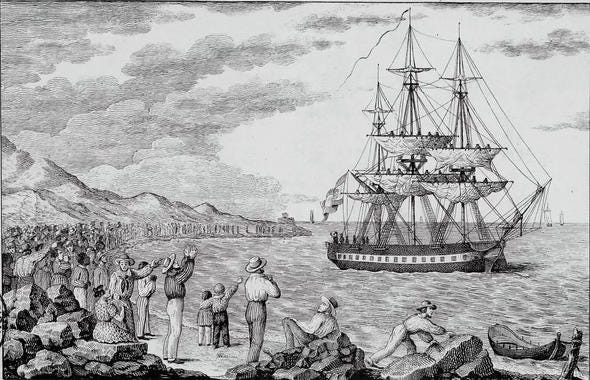
For me, given my current obsession with opposition to vaccination and its history, that takes me to one of the most extraordinary incidents in the history of public health, the Balmis-Salvany Expedition of 1803-1813.* (Yes, really, there’s a connection to be found between that odyssey and today’s Venezuela news. I promise…read on.)

The Balmis Expedition (as it’s often shortened) was the Spanish Empire’s project to deliver the then-brand-new smallpox vaccine to its imperial domains in the Americas and the east coast of Asia (the Philippines and Macau). Over its ten year span, several hundred thousand people were inoculated with material from cowpox pustules using the method developed in 1796 by the English country doctor Edward Jenner. The vaccination networks the expedition established would reach millions more after the journey’s end.
The Balmis expedition is often seen, reasonably enough, as the first proto-modern public health campaign: a government initiative to intervene in a disease process on a massive scale; one that aimed to protect whole populations against a lethal threat.
That’s one facet of the historical experience. It shouldn’t be discounted or dismissed. Before Jenner’s vaccine and its predecessor, variolation, inoculation with scrapings from sores of (hopefully mild) smallpox itself, smallpox was perhaps the most constant of the infectious diseases that were the leading killers of humankind as recently as the nineteenth century. The decision to bring a new, lifesaving technology to the colonies saved uncountable lives. Within just a few years after the Balmis expedition concluded, some of those people would have witnessed, perhaps taken part in the liberation of Spain’s American colonies.
But any framing of the Spanish empire acting as a solicitous central power working in the best interests of its subject peoples is far from the whole story—so much so as to be functionally false. There are libraries of scholarship on the expedition itself and its context in the exercise of imperial power, way too much to summarize here. But the cartoon version is pretty simple. The wealth Spain derived from its colonies in the Americas depended on the labor of the indigenous people who had fallen under their control. The introduction of Eurasian diseases into the western hemisphere had already led to vast loss of life. The Spanish administration recognized in the Jenner vaccine a tool to be used to preserve a resource—the stolen bodies grabbing the resources of what was to their overlords a new world.
In that context the Balmis expedition can both abstracted from its immediate circumstances to be recognized as a prototype of a public health intervention, and, in its actual historical moment, as an intervention by a brutal absolutist authority defending its interests with any tool at hand.
And that, tenuously, is where we can cross a bridge to our own particular place and time.
As the title says, history doesn’t repeat itself, but it knows the chords. So here’s one resonance between Balmis’s zealous vaccinators and US Special Forces: there seems to be broad agreement that Venezuelan President Maduro was a bad actor across a whole bunch of domains. Bad enough that for many, removing him can be seen as a good thing, whatever the means employed. Certainly preventing smallpox was a good thing, a boon we now all enjoy, thanks to a vaccination campaign in the 1960s and ‘70s that drove the virus to extinction in the wild.
And here’s the overtone that makes the chord: when President Trump said out loud that the US now plans to “run” Venezuela and control its oil resources, he confirmed what he and his administration set out to do: to secure a 21st century version of an imperium in the Americas.
So far, that’s pretty much a penetrating glimpse of the obvious; I’m hardly the first, or even in the first 10,000 or so to say something like that. But take one more step through this 19th century window on today’s news. The movements that led to the breakup of Spain’s American empire had begun while the Balmis expedition was still doing its work, with the wholesale disintegration of Spanish rule in the hemisphere following in the 1820s.
The vaccination campaign that was thus one of the last continent-wide projects of the old regime can’t be said to be one of the reasons Ferdinand VII’s power shattered then. Similarly, I’m think it’s pretty unlikely that the kidnapping of Maduro and his wife will the event that drives Trump from the off stage while the MAGA movement shatters.
But it is important to think about how the naked exercise of power for corrupt and extractive self-interest speaks to those who witness it. That message was legible in 1813. It remains so today.
And after all that: this thread is open.
*A good starting point for more background on the Balmis Expedition comes from Catharine Mark and José Rigau-Pérez, “The World’s First Immunization Campaign: The Spanish Smallpox Vaccine Expedition. 1803-1813, Bulletin of the History of Medicine, Spring 2009, Vol. 83 No. 1, pp 63-94.
Image: Engraving by Francisco Pérez: The Balmis Expedition setting forth from Corunna on the corvette Maria Pita, bound for Spanish America. 1803
The post History Doesn’t Repeat Itself. But It Knows The Chords appeared first on Balloon Juice.


Saint James Talarico (he/him)
David Harsanyi, Washington Examinerمصدر …
